

Acknowledgement: This project is funded by the National Science Foundation (NSF) under award # 2434021
Team Members
-
Dr. Marwan Krunz
-
Rabiul Md. Hossain (Ph.D. Student)
-
Sopan Sarkar (Ph.D. Student)
-
Dr. Diep Nguyen (Collaborator)
-
Dr. Yong Xiao (Collaborator)
Project Goals
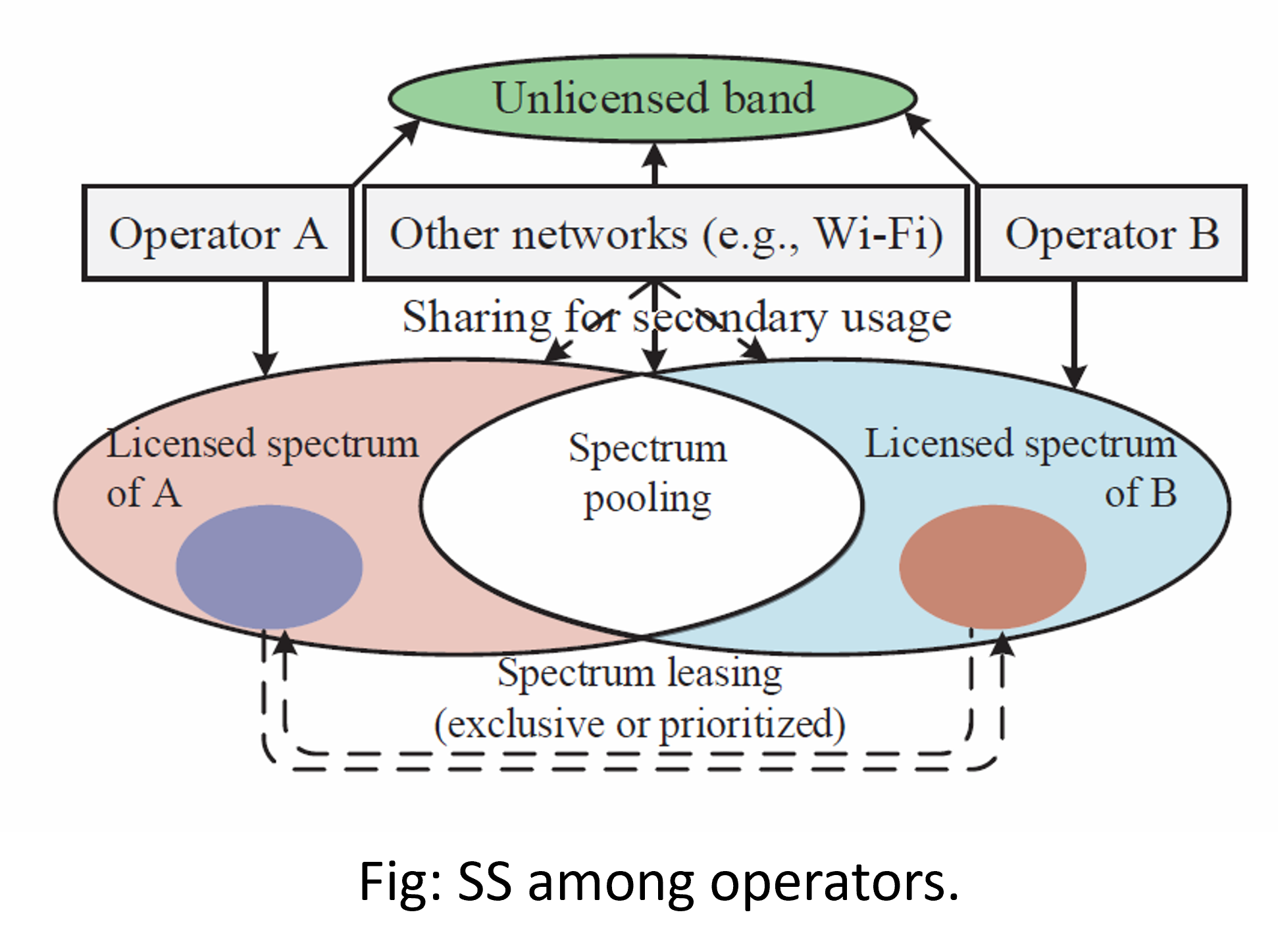
The overarching goal of this project is to lay out a theoretical foundation for the economics of multi-operator spectrum sharing (SS) over both licensed and unlicensed bands considering market uncertainties. Despite intensive efforts to assign more of the electromagnetic spectrum for mobile broadband, it is now widely believed that the traditional exclusive spectrum assignment approach is too limiting to meet the high demands of next-generation (NextG) wireless networks. SS remains critical at all frequency bands, including sub-6 GHz, millimeter-wave bands, and FR3 bands (7.125 to 24.25 GHz). To usher a new era of SS of licensed and unlicensed bands between (bilateral) and among (multilateral) wireless operators, new sharing models are needed. At their core, these models should incorporate proper incentivization mechanisms, as profit is ultimately the primary factor that motivates operators to share their spectrum. This project focuses on novel privacy-preserving game theoretic models for SS that are particularly suited for exploitation of the short-term spatiotemporal variations in traffic demands between operators.
The research agenda is organized into three thrusts.
-
Thrust A: Non-collaborative SS Between Operators: In reality, there are numerous situations in which operators prefer not to collaborate. For example, operators of similar market powers tend to treat each other as competitors, and would consider their internal states (e.g., traffic load in a given area) as private information not to be shared. To study an operator’s optimal decision making under uncertainties about other operators, we are investigating several novel game-theoretic models, including: (i) a repeated double-side Bayesian spectrum auction game with transferable seller and buyer for inter-operator SS over licensed bands. Unlike a classical double auction, in this game, the role of an operator (seller or buyer) and the amount of spectrum to sell/buy in an auction is an output of the game, rather than an input to the auction. (ii) An incentivized oligopoly game and a repeated single-side spectrum auction game with unknown and private valuation for SS over unlicensed bands (for distributed and centralized SS scenarios). (iii) Novel online reinforcement-learning formulations to understand how an operator may take advantage of the outcome of past games to improve its current decision making.
-
Thrust B: Collaborative SS between Operators: Collaboration between operators can potentially bring mutual benefits, but it may also harm their interests if is not carefully managed. Understanding these complex interactions requires new game theoretic models for both licensed and unlicensed spectrum. We propose to: (i) Explore coalitional game theory to model the interactions between operators when a mutual agreement can be negotiated. Two scenarios are being investigated for licensed-band SS: Limited spectrum pooling (LSP) and mutual renting (MR). (ii) For inter-operator SS on unlicensed bands, we introduce the concept of value-of-right to characterize the benefit that can be obtained by each operator from the unlicensed bands. Based on this concept, we are developing a novel inter-operator-right-sharing framework in which different operators can privately purchase or exchange rights for accessing the unlicensed bands. (iii) We are developing distributed and privacy-pr serving mechanisms for operators to negotiate with each other without directly revealing their private information.
-
Thrust C: Collaborative SS between Heterogeneous Wireless Systems: Cellular operators can lease part of their underutilized licensed bands to other non-cellular systems for exclusive or prioritized access in order to further increase their revenue. In another scenario, when multiple operators offload traffic to the unlicensed band, they need to take into account the impact of their behavior on other coexisting wireless technologies (e.g., Wi-Fi). In both cases, cellular systems will interact with non-cellular wireless systems. To analyze the economic implications of these interactions, we are: (i) exploring a hierarchical game framework that consists of a multi-leader multi-follower Stackelberg game that models the interaction between cellular systems (leaders) and other wireless technologies (followers), (ii) developing a Bayesian overlapping coalition formation game to model the competition and collaboration among operators over both licensed and unlicensed bands, and (iii) investigating a Bayesian reinforcement learning-based algorithm to analyze various desirable equilibrium solutions for the proposed games.
Representative Publications
Yong Xiao, Xubo Li, Haoran Zhou, Yingyu Li, Yayu Gao, Guangming Shi, Ping Zhang, and Marwan Krunz, "SANet: A semantic-aware agentic AI networking framework for cross-layer optimization in 6G," to appear in the IEEE Transactions on Mobile Computing, April 2026.
Yong Xiao, Haoran Zhou, Yujie Zhou, and Marwan Krunz, "SANEmerg: An emergent communication framework for semantic-aware agentic AI networking," accepted for the IEEE/IFIP International Symposium on Modeling and Optimization in Mobile, Ad hoc, and Wireless Networks (WiOpt’26) – Workshop on Modeling and Optimization for Semantic Communications (MOSC) Conference, Columbus, Ohio, June 2026.
Huixiang Zhu, Yong Xiao, Yingyu Li, Guangming Shi, and Marwan Krunz, “SANSee: A physical- layer semantic-aware networking framework for distributed wireless sensing,” IEEE Transactions on Mobile Computing, vol. 24, pp. 1636-1653, 2025.
Zhiwu Guo, Wenhan Zhang, Ming Li, Marwan Krunz, and Mohammad Hossein Manshaei, "DL-SIC: Deep learning aided successive interference cancellation in shared spectrum,” Proc. of the International Conference on Computing, Networking and Communications (ICNC) - AI and Machine Learning for Communications and Networking Symposium, Feb. 2024.